Photo courtesy of Bud Smith.
After eight glorious weeks of freedom, I was reinstated.
The first thing I did was walk to the engine shop to look for my F-150. The oil stains are there, but not the truck. It also wasn’t in the rock spot where the bulldozer was parked.
Who would have the heart to take such low measures? There is no heating and no air conditioning. The radio was bubbling with static. There is no door handle. The floorboards, fenders, and frame were all rusted and rotted. Of course so‘that can be called roadworthy. And, my God, the smell.
I went to the machine shop. One of the welders opened the hood and told them the bad news—they had to move the truck for a shipment of steel and the old thing’s engine had finally failed, so the truck was dragged to the dump.
In a dusty corner, I saw a pile of equipment salvaged from a truck. I grabbed some wrenches and a measuring tape but didn’t see what I was really looking for—my Truck Table®. Oh okay.
I got a ride to the unit with the foreman and the rest of the crew. Our goal today is to unlock components of the heat exchanger and flying them with a crane. Once the exchanger is taken apart and inspected, we will begin the actual repair.
The morning went well. Mornings always go well. Everyone knows what they are doing. We are professional, equal. Same salary. Same benefits. Everyone works together towards retirement. We look after each other. Whoever has the hardest job on the crew today can be the foreman tomorrow, and vice versa. No one wants to be the boss, so our bosses are the best.
At the first break, we piled into the truck and drove shoulder to shoulder back to the trailer complex for coffee. During the five-minute drive, I couldn’t help but think about how much fun I’d have if I had the luxury of a damn F-150.
See, the truck no one else wants is my office. I’ve built a portable table in it. My truck table, I call it. Several boards were screwed together, our union stickers were applied, the whole deal was sealed with shellac. I’ve built the table so it slides to the bottom of the steering wheel and rests on the arm rest. I used to put off work and sneak in some creative work while the rest of the crew took a break. My desk—which had taken too long to build and perfect over many prototypes—had been stowed behind the driver’s seat while the truck was hauled away by the towman.
Back in the break trailer, I took my old chair and joined in the jokes, insults, and tales. The trailer, to me, is the best place for storytelling in the world—but, as usual, it’s too loud, too raucous, too fun to write or read, which is the only thing I want to do on my break. At lunch, I walked into a relatively quiet machine shop. I sat down near the drilling machine and took out my phone and started writing. Like I usually do.
For almost two decades I worked continuously at this petrochemical plant as a mechanic and welder. The union sent me here: When things slowed down, I was laid off; when the work started, it backfired on me again. And all the time, I wrote stories and parts of my novels during breaks—fifteen minutes for coffee and then half an hour for lunch. I also take advantage of delays caused by lightning, severe rainstorms, evacuations, permitting issues, equipment problems, and so on. I am grateful for every delay that occurs on this construction site, and believe me, there are many.
Most artists I know are like this. Finding time to make art while working another job, or caring for a loved one. They improvise. They get better. They get worse. They get even better.
In fact, this mostly comes down to the first thing: finding the time. When I talk to people who want more time, I repeat what the old people told me: “You have to make your own terms.”
What does that mean? Well. Is it raining? You can stand in the rain and get soaked, or you can find a roll of binding wire and hang a tarp for the hooch.
There is another saying that I like, which is: “Let your wallet be your guide.” I try to remember it every time I feel the urge to quit my job and never go back.
So since phones got smart, I sit in a quiet place, half an hour, sending myself poems, paragraphs that become stories and novels, and things about my life, or should I say. lifelike the thing you’re reading right now.
Writing on my phone, while pecking away, was fine for years, but then after a decade of manual labor, I started to have irrational fantasies about ease and comfort.
Of course I have a desk in my apartment, but I can’t help myself. Somehow I was tempted by the prospect of getting my own cubicle in the middle of a huge junkyard full of toxic waste.
One day I walked into the payroll trailer where the secretary and location manager were sitting. There is no explicit sign that says NO CONTRACTORS ARE ALLOWEDbut that is an unspoken rule. The trailer had several old, unused cubicles tucked away to the side. I sat on one and happily pecked with my thumb. Every break during the week I log in and work on my writing. After a few days, I started to feel like I should hang photos of my mom, dad, and wife in it. But I didn’t dare.
Then things got heated. I brought a Bluetooth keyboard and wrote the entire story of the day during my break. There is no turning back. My heart jumped. I think I should adopt a brown dog with a bandana around his neck so I can stick his photo on the cubicle wall. I had never interacted with any of the office staff, but they saw me. They followed my greasy shoe prints down the hall and started leering. Who is this contractor who smells of diesel? He’s probably the one who ate Janelle’s Oreos. He raided the mango-kiwi yogurt from the refrigerator. He destroys all the sporks. I knew my cubicle dreams were over in the morning when I found the location manager waiting in “my” cubicle.
“What are you doing here?” he asked.
In all the years I’ve worked there, I’ve never seen a location manager on site. I’m not sure he knows what it is or where it is. You go to him to order equipment; he was the one who said no. I’ve only ever seen him at the urinal or buying bacon and eggs from a lunch truck. But if I had seen him at that location, it would never have occurred to me to ask what he was doing there. He was wearing a blue polo shirt and khakis, and I was in his world—and he was asking.
“Office work,” I said.
“What kind exactly?”
How can you explain literary fiction to a location manager?
“A little bit of everything,” I said.
I started writing in the machine shop again. It’s not the same. Once I was infected with the cubicle virus, there was no turning back. From scrap wood I collected from various dumpsters, I made a proper table for myself in the northeast corner of the shop. The table was a quantum leap in possibilities and productivity. In the evening, if I wrote something by hand or on a typewriter at home, I can now use my time at work to retype it at my shop desk.
The shop table is not ideal. One day I arrived to find someone had dismantled the small motor on it, the gaskets and hardware scattered in the newspaper. Other times I found pneumatic weapons disassembled, or electrical devices with wires scattered in colorful tangles, or—fair enough—important blueprints laid out along the table.
That’s when I first saw the F-150. One of the workers had left it near the shop. I installed the battery. It lasts one shift. Then I took the alternator out of another junk truck and, lo and behold, I had four wheels of my own. The fan belt screamed. The engine is smoking. The brakes work when they want them to. It was mine all that dangerous year.
Then, one day, my luck changed.
A crate full of drop chains has been delivered. It was a magnificent chest, made of sanded spruce. I opened up some boards and created my first Truck Desk prototype.
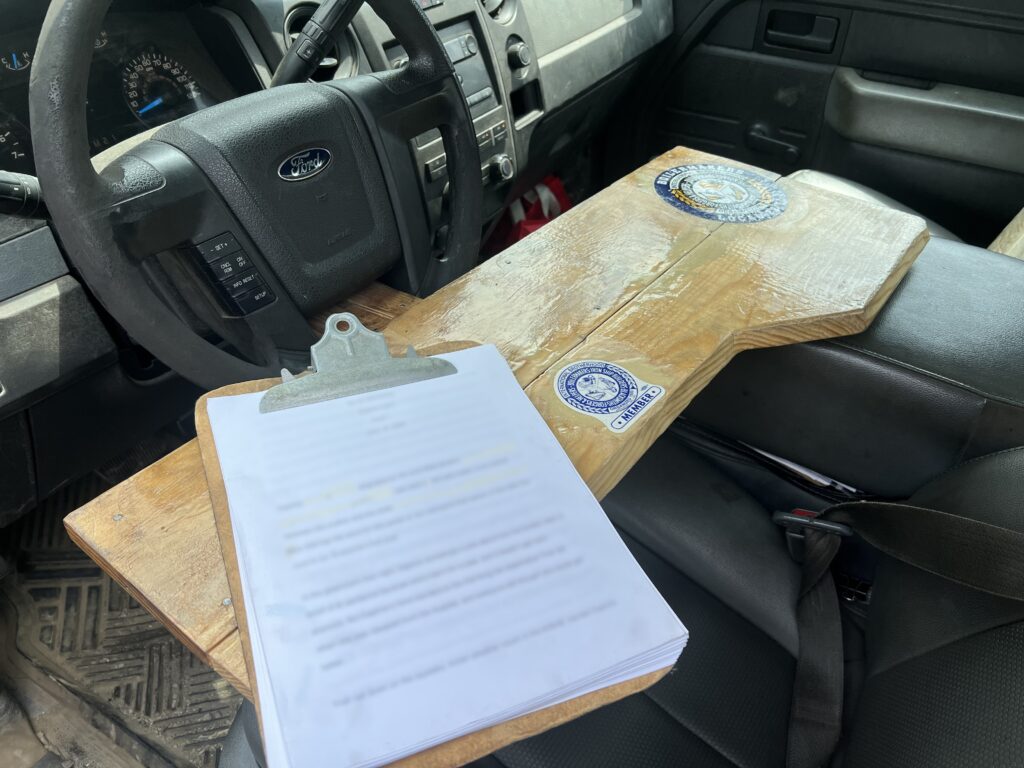
Photo courtesy of Bud Smith.
It is made of three planks cut to twenty-four inch lengths. Light and compact. Sealed with shellac. It slides into the bottom of the steering wheel, one side of it supported by curved rebar that I welded into a nut that fits into the recess in the driver’s door. The center console supports the other side of the table. I keep it behind the chair. Whenever break time comes and the crew heads back to the trailer complex, I stay parked in the unit and get at least an extra ten minutes to write.
Now that I have a Truck Desk, the vehicle is my own rolling booth.
Having that truck reminds me of when I lived on 173rd Street in New York City. At that time I used to drive around endlessly looking for a parking space on the side of the road. I saw men and women sitting in their cars. But they will not go away; they read books or magazines, smoke, play Sudoku, write love letters. They are the wisest men and women in all the city, who use their vehicles as a kind of office on the road, a sanctuary where they can do their real work.
After the F-150 was scrapped, I never got a replacement truck. I also never found the first Truck Desk, even when I called the scrap yard.
But what I did was go to the carpenter’s side of the shop and cut twenty-nine inch high scaffolding boards. This simple board fits in the armrest of whatever Chevy or Ford pickup the crew has that day. Dramatic redesign of the Truck Desk into a Truck Plank® takes ten seconds. I don’t care about stickers or shellac.
Years of work have passed. Now the editor sends me a Word document with comments and questions and tracked changes. I bring my backpack to work with my laptop in it.
Every morning, when I find out which crew I’m on, I take the board with me. I stuck it on the dashboard and climbed into the driver’s seat. I drove us all to work and during breaks I took them to the trailer. I cleaned my hands with pumice wipes and sat alone in nobody’s truck that day, pulling the board off the dash and placing it on the armrest. Within a minute or so, I pulled out the laptop and started working. If someone from the crew is still sitting in the back seat, with a blindfold over their eyes, asleep, I try my best to stay extra calm. And if they start snoring, I don’t let it bother me at all.
Bud Smith is the author of the novel Teenager and a collection of stories Double Bird, among other books. Strong, a novel, to be published from Knopf in spring 2027. The story “Sky Eagle” appears in the new Fall issue Paris Review.
News
Berita
News Flash
Blog
Technology
Sports
Sport
Football
Tips
Finance
Berita Terkini
Berita Terbaru
Berita Kekinian
News
Berita Terkini
Olahraga
Pasang Internet Myrepublic
Jasa Import China
Jasa Import Door to Door
Originally posted 2025-10-31 12:49:32.