šalḫanti-/šalḫiyanti- lexical filing card, with this paragraph from Disappearance of Telipinu in the Chicago Hittite Dictionary. By permission of the author.
For our Poetry Making series, we ask poets and translators to dissect the poems they publish in our pages. Naomi Harris’s translation of three Hittite poems appears in our new Fall issue, no. 253. Here, we ask Harris to reflect on his translation “Telipinu go.”
The Hittites spoke an Indo-European language and ruled a large empire in the Late Bronze Age, which is now called Türkiye. Their capital is multicultural and multilingual. Their language, which we call Hittite, they called Nešili, the language of Neša. “Telipinu go” translates a paragraph from the Hittite text we mentioned Disappearance of Telipinu. The text was written in cuneiform script on a clay tablet, which was discovered at the Hittite capital Ḫattuša, near modern Boğazkale in Çorum, Türkiye. There are several versions, and they were copied many times throughout Hittite history; this one dates to around 1450–1350 BC
“Telipinu go” is a quote from a longer text. Can you tell us about it?
In the full text, the god Telipinu, son of Stormgod, became angry and left, taking all the good things with him. Famine and disaster occur in both the mortal and divine realms. Water, mountains and forests dry up. Cows no longer recognize their calves. The ewe no longer recognizes the lamb. The world is twisted and unable to unite. No one can get pregnant, and those who are pregnant cannot give birth. The Sun God threw a feast, and although the gods ate and drank as usual, they still felt hungry. When Stormgod realized that his son was gone, the great gods and small gods looked everywhere for Telipinu but did not find him. Sungod, the host of the feast, sent an eagle flying quickly, but the eagle did not find him. Stormgod made a pathetic attempt to find his son and gave up too soon. Finally, the grandmother goddess, Ḫannaḫanna, sent a bee which found Telipinu and stung him awake. The bees return Telipinu, and they perform a ritual full of beautiful imagery to relieve his anger and reconcile him again with the world.
The paragraph I focus on, KUB 17.10+ §5′, reads as follows—
Dtechnology
halkin DIshalḫianin manditin Ishpiyatarr=a pēda gimri wēlugo.
Dtechnology
šēr=a=šši=ššan ḫalenzu ḫuwaīš
so ḫalchich ZÍZ tar UL No
numeric4ḪI.A FOGḪI.A DUMU.LÚ.U19.LUmesh UL Armaḫḫansi
armauwanteš=kuieš
no=za ape=ia UL ḫaššanziTelipinu left.
He brings wheat, Prosperity (deification), growth, abundance, and contentment; to the fields, to the meadows, to the meadows.
Telipinu went away, and he hid in the moor,
and duckweed ran towards him.
After that, grain and emmer no longer grow.
Cows, sheep and humans no longer get pregnant,
and those who are pregnant,
they also no longer give birth.
The repetition of “Telipinu go” is inspired by the grammatical features of the original lines—
Dtechnology
Telipinu left, and he hid on the moor
In Hittite, to say “At that point/where”, a sentence pairs the verb “go” with the main verb of the sentence, which is called a phraseological construction. So we can read it as two clauses, “Telipinu went away, and hid in the moor,” or we can read it as a single sentence built from the previous information given in the text—”He brought grain, (deified) prosperity, growth, abundance, and contentment; to the fields, to the meadows, to the moor. Then Telipinu hid on the moor.” Given its grammatical ambiguity, does the phrase “Telipinu went” actually mean he went somewhere, as we know? Or does the text use the verb “bittermeaning “to go,” to indicate a causal relationship between taking the good stuff and hiding on the moor? This multivalence reflects two main issues in the text—that Telipinu is no longer here and that he took good things with him. His father, the Storm God, said when he realized why all the gods were still hungry, “Telipinu, my son, is not here. He became angry, and he took everything good with him.” The duality that Telipinu leaves behind and goodness brings with it, is captured in the grammatical ambiguity of this sentence.
What were the challenges of this particular translation?
It was difficult to take the text far enough beyond conventional poetry in English, to make it recognizable to a culture separated by distance, millennia, and language from its original Hittite readers. I have made a number of poetic translations of it Disappearance of Telipinu. For “Telipinu went,” I chose a form familiar to readers who may have never heard of the Hittites. My translation is repetitive, rhythmic, and rhymed, relying on literary strategies that were not dominant in the original Hittite composition.
For words that we don’t fully understand, such as šalḫiyanti– And mannitti-, a term that refers to something that is good in nature, I substituted butter and chocolate. There was definitely no chocolate in Bronze Age Anatolia. I translated the Hittite concepts of growth, abundance, and good things into the necessities, comforts, and luxuries of life, some of which have persisted for three thousand years, such as housing, water, agricultural production, and love, and others that have been abandoned—such as messages from the gods written in sheep’s entrails—or found along the road, such as chocolate.
How did you feel when you wrote the first draft? Does it come easily or hard? (Are there difficult and easy translations?)
The first four lines of the poem came to mind easily, at seven thirty in the morning in a cafe where I sometimes met my friend Crystal and we wrote letters to each other. I sat in that first row for over a year—it took a long time for the next row to appear.
Understanding the Hittite language from the original paragraphs is not as difficult as it sometimes seems. The expanse of the tablet is unbroken, and the cuneiform marks are neat and well preserved. The poetic syntax is somewhat unusual. Hittite is usually a final verb, but in the second clause here, “halkin DIshalḫianin manditin Ishpiyatarr=a pēda gimri wēlugo.,” which translates to “He brings wheat, Prosperity (deified), growth, abundance, and contentment; to the field, to the meadow, to the moor,” field, meadow, and moor are shifted after the verb footmeaning “he took away”. They sit almost outside the sentence, forming an unusual grammatical feature that highlights how Telipinu brings these good things to external places.
The paragraph has some special terms that are not fully understood by Hittitologists šalḫiyanti– And mannitti-. These words appear as a pair in Hittite texts and have meanings such as growth and abundance, although their exact meaning, as understood by the Hittites, is unclear. Chicago Hittite Dictionary, which is the most comprehensive dictionary for Hittite words starting with L, m, N, PAnd Swith Q in his work, offers “growth (?)”, with a hesitant question mark šalḫiyanti-, and, more definitely but less specifically, “(desirable condition in nature)” for mannitti-. A comprehensive dictionary for a dead language is a project on a large scale and is the most necessary tool for a philologist. Scholars working on these entries in dictionaries examined every instance of these words appearing in Hittite texts.
When did you know the translation was complete? Are you right about that? Is everything finished?
In an early attempt, I tried to add to the translation, expanding it into an epic poem encompassing the entire myth, but the poem collapsed under its own weight. I’m glad I stopped doing that, because the focus of this little story about the climate crisis would have been diluted by the activity of the gods running around.
However, I have several sentences that make me sad to part with him, including
Eagle went and looked for Telipinu
It searches across mountains, valleys, and deep blueHe searched the slopes; A wasteland that is rocky and has no roads
He searched until he flew back into the god’s hands.Stormgod left, and he gathered his equipment.
He gathered his hammer, his chisel, and his rules.
Do you regret any revisions?
No. In the initial draft, I grouped “science, crops, and remedies”, like this—
He took away knowledge, crops, and medicine
He took him to the meadow, to the swamp, to the meadow.
I love these lines, but I end up breaking and spreading these concepts throughout the poem. It took many drafts to figure out how to incorporate science, production, and medicine in a way that made sense and worked! But breaking it up allowed me to include the last two lines, which I think improves the final result. In previous drafts, I would have ended the poem here, with Telipinu bringing good things to the prairies, marshes, and moors, but I like that I can use the current ending to say explicitly that Telipinu has abandoned us all, which is the anxious tone of the Hittites, who have abandoned us all.
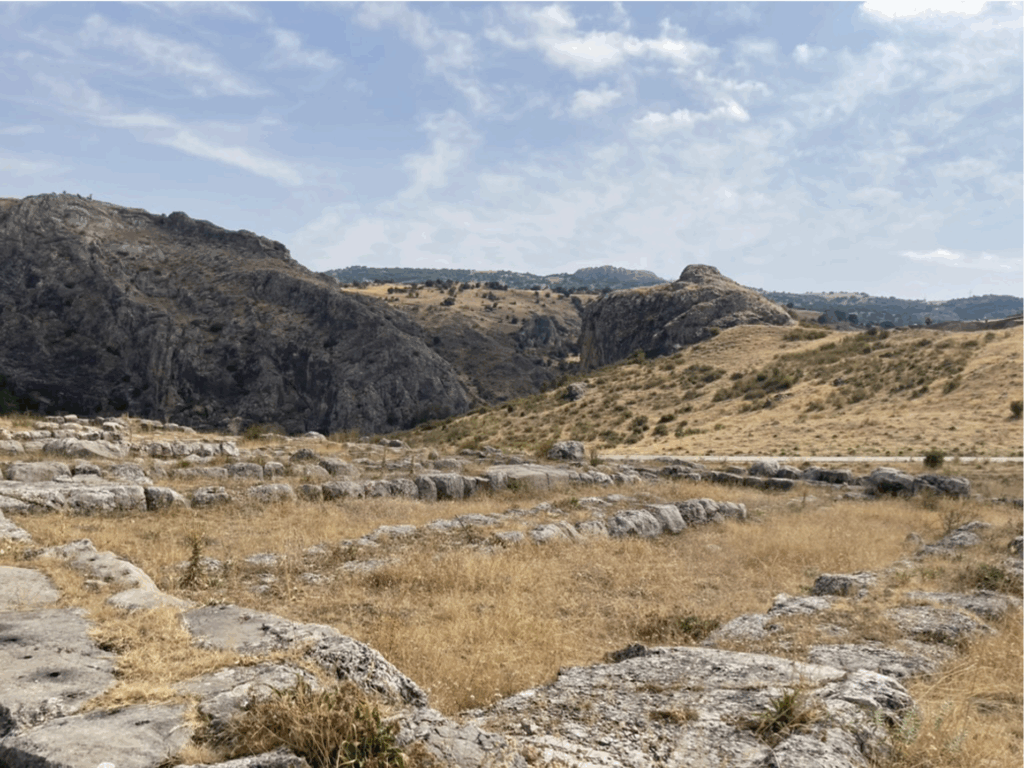
Temple 1, in Ḫattuša (Boğazkale); the text was found not far away. By permission of the author.
Naomi Harris is a translator of Hittite poetry.
News
Berita
News Flash
Blog
Technology
Sports
Sport
Football
Tips
Finance
Berita Terkini
Berita Terbaru
Berita Kekinian
News
Berita Terkini
Olahraga
Pasang Internet Myrepublic
Jasa Import China
Jasa Import Door to Door
Originally posted 2025-11-22 14:52:48.